Category: Energy Security & Critical Infrastructure Risk
As of 1 July 2026, Ukraine’s energy security position is materially stronger than it was in the first months after full-scale invasion, but materially weaker than would be required for a low-risk winter. The system has developed operational resilience through emergency repairs, European interconnection, distributed generation, donor-backed equipment procurement and gas supply diversification. Yet the same system remains highly exposed to renewed attacks on generation, substations, gas production, storage-related surface infrastructure and district heating assets.
The electricity system is operating under conditions of constrained domestic generation, high dependence on nuclear availability, reduced dispatchable thermal and hydro flexibility, and an increasing need for cross-border imports and balancing resources. Publicly verified sources do not provide a single authoritative figure for fully available generation capacity on 1 July 2026. However, current official and institutional sources confirm substantial cumulative damage to generation and networks, a significant power deficit at the beginning of 2026, continued power-system constraints during the first quarter, and a policy focus on new decentralised and gas-fired generation.
Nuclear generation remains the backbone of Ukraine’s controllable electricity supply, but the February 2026 grid instability episode reported through Ukrainian parliamentary channels citing the IAEA showed that power-system disturbances can force nuclear units to disconnect or reduce output. This makes transmission resilience, substation protection and external power reliability central nuclear-safety and electricity-security issues, not merely grid-engineering concerns.
Gas security is also under pressure. Naftogaz has diversified supply routes through U.S.-sourced LNG delivered via Poland, Germany and Lithuania, and has secured longer-term access to European LNG infrastructure. At the same time, Russian attacks on oil and gas infrastructure continued through the first half of 2026, including production assets in Poltava, Kharkiv, Sumy, Dnipropetrovsk and Zaporizhzhia regions. This has direct implications for domestic production, storage injections and the volume of imports required before the heating season.
Europe’s gas market conditions are less benign than a simple LNG-supply-growth narrative would suggest. ACER, IEA, ICIS and S&P Global Commodity Insights all point to a market shaped by storage refill pressure, LNG competition, Middle East-related supply disruption risk and volatile hub pricing. S&P Global reported EU gas storage at 48.3% on 27 June 2026, materially below the same dates in 2025 and 2024, while ICIS estimated Western and Central European stocks at 46% at the start of week 26. For Ukraine, this means European import availability is likely to remain price-sensitive through the third quarter.
The strategic winter question is therefore not whether Ukraine can operate its energy system under attack; it has repeatedly demonstrated that it can. The question is whether repairs, equipment deliveries, gas procurement, decentralised capacity additions, cyber preparedness, local heat resilience and financing can move fast enough before sustained winter demand returns.
Ukraine’s power system remains in a condition best described as operationally functional but structurally stressed. The main pressures are damaged dispatchable generation, repeated damage to substations and transmission infrastructure, limited reserve margins, high repair intensity, and the difficulty of maintaining adequate balancing resources while system assets are under attack.
During the first quarter of 2026, Energy Community reporting showed that emergency measures continued to shape electricity-market operations. Selected state-owned enterprises were required to procure imported electricity during the autumn-winter period, and price caps on the day-ahead, intraday and balancing markets were changed frequently to support imports and system stability. These measures helped manage a deficit but reduced regulatory predictability for market participants.
The current generation mix is more fragile than the pre-war structure. Nuclear power remains the dominant source of stable domestic output; thermal power has been heavily damaged and fuel-constrained; hydro and pumped storage provide important balancing services but have also faced damage and equipment needs; renewables contribute valuable daytime energy, especially solar, but cannot by themselves replace firm capacity without storage and flexible backup.
Nuclear generation is Ukraine’s core baseload resource. The continuing occupation and non-availability of Zaporizhzhia Nuclear Power Plant capacity remains a structural loss. The remaining nuclear fleet is critical for system adequacy, but its security depends on the reliability of external grid connections, substations and high-voltage lines. The February 2026 incident reported by the Verkhovna Rada, citing the IAEA, underlined the risk: power-system damage and disconnections led one nuclear unit to disconnect automatically and other units to reduce output, while Chornobyl NPP temporarily relied on emergency diesel generation after loss of external power.
For Winter 2026–2027, nuclear generation is therefore a stabilising asset and a system-risk concentration at the same time. It reduces fuel import exposure but increases the premium on grid protection, operational coordination and rapid substation repair.
Thermal generation remains the most important source of dispatchable non-nuclear electricity but also one of the most damaged segments of the power system. Thermal power plants and combined heat and power facilities are large, identifiable and difficult to harden fully. Their role in winter is especially important during evening peaks, low-renewable periods and heat-demand events.
Energy Community’s Q1 2026 annex records public reporting that 1.4 GW of gas-fired generation had been commissioned in Ukraine since the start of the full-scale invasion, and that approximately 9.5 GW of new generation would be required in the near future. These figures indicate the direction of system planning: smaller, distributed and gas-capable generation is becoming essential to resilience. However, gas-fired generation adds another dependency: adequate gas availability during winter peaks.
Hydropower and pumped storage are important for balancing, frequency control and peak management. In January 2026, emergency measures required Ukrhydroenergo to purchase imported electricity at night to fill the upper reservoir of the Dniester pumped-storage plant by the end of March. This illustrates the value of pumped storage in shifting imported or off-peak energy into peak periods.
The EBRD’s 2026 financing package for Ukrhydroenergo, including EUR 75 million for critical hydro equipment and emergency reserve stock, confirms the strategic importance of hydropower assets and the continuing need for specialised equipment. Hydropower resilience will be especially important if thermal units face damage or fuel constraints during cold spells.
Renewables are increasingly important for resilience, particularly solar generation paired with batteries at critical facilities. The Energy Community reported that Ukraine’s February 2026 Law No. 4777-IX strengthened the renewable framework by introducing a market premium mechanism, extending support auctions to 2034, encouraging combined solar-plus-storage projects and providing for guarantees of origin.
The near-term limitation is that solar output is seasonally and hourly variable, while wind capacity remains regionally constrained by security conditions, grid availability and investment risk. The Ray of Hope initiative, under which 687 healthcare facilities had been selected and 265 sites were underway by June 2026, demonstrates the practical resilience value of decentralised solar and battery systems even when they do not solve national adequacy alone.
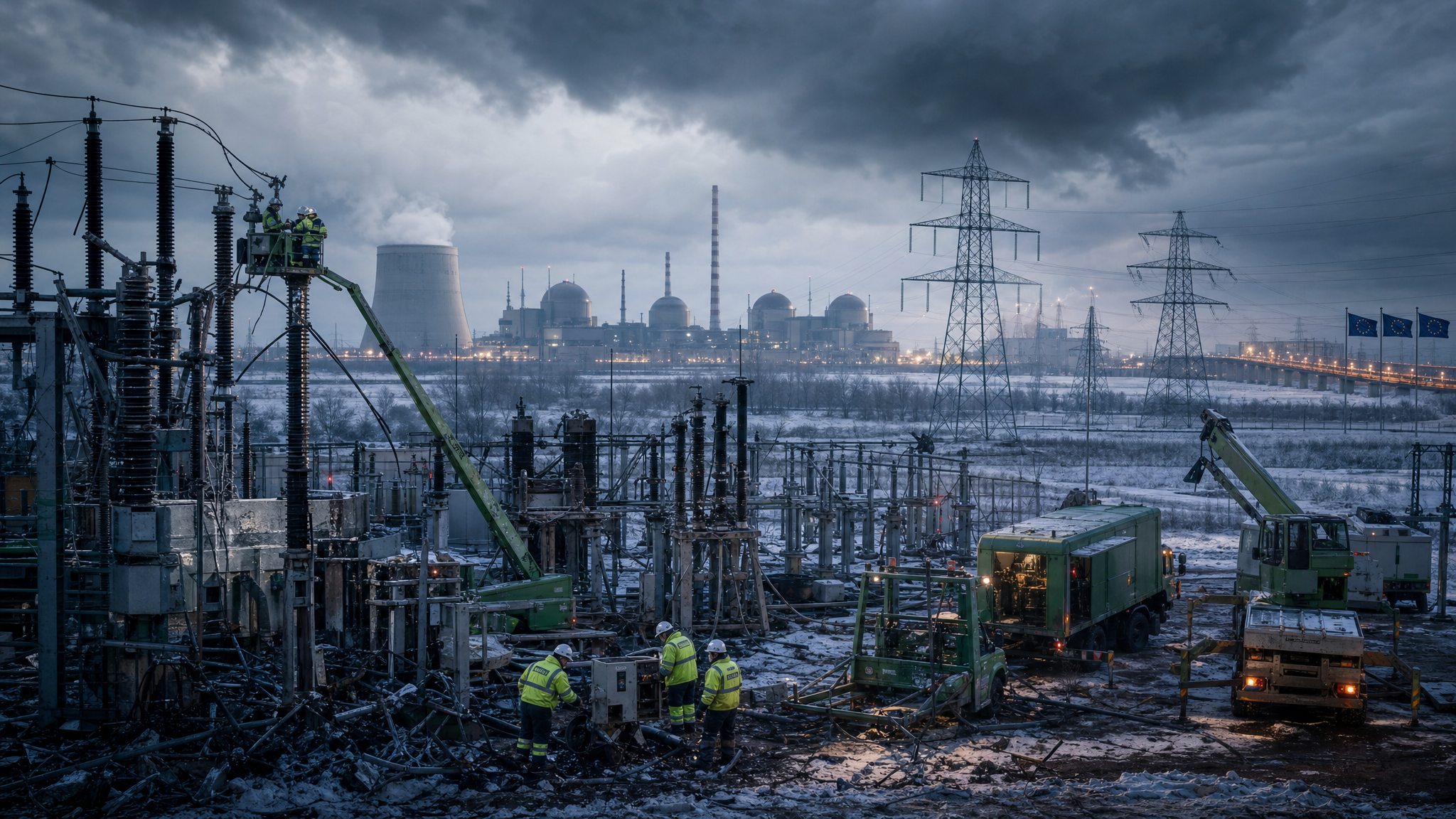
Transmission infrastructure is the central operational risk for Winter 2026–2027. Even where generation exists, damaged high-voltage substations, transformers, protection systems or lines can prevent electricity from reaching load centres. Equipment shortages, long transformer lead times, logistics constraints and insurance limitations increase restoration risk.
EBRD’s June 2026 commitment of EUR 90 million to Ukrenergo for reconstruction of selected substations is a significant positive development, but it should be understood as part of a larger repair and resilience requirement. Substation resilience is not only a matter of replacing destroyed assets; it requires spares, mobile transformers, physical protection, redundancy, cyber-secure control systems and trained repair crews.
Balancing remains difficult because Ukraine must integrate damaged thermal assets, seasonal hydro constraints, nuclear baseload, variable renewables, changing import volumes and emergency demand management. In a system with limited reserves, a single large outage or attack on a substation can produce cascading operational effects across generation, transmission and distribution.
Ukraine’s gas position ahead of winter depends on four variables: the pace of storage refill, domestic production recovery, European import availability and the intensity of further attacks on gas infrastructure. Argus reported that Ukraine had 9.9 bcm in underground storage on 8 April 2026 and was targeting 14.6 bcm ahead of the heating season, with a 13.2 bcm minimum requirement for winter stability. The gap between these levels and actual stocks by autumn will be one of the most important winter-risk indicators.
Domestic production has been repeatedly targeted. Naftogaz reported that attacks in 2025 caused loss of domestic production and forced additional gas imports. In 2026, attacks continued at high frequency across production and storage-related assets. Late-June attacks on production assets in Poltava and Kharkiv regions came only days before this assessment date, making the near-term production outlook uncertain.
Naftogaz’s supply diversification has reduced single-route risk. U.S. LNG has reached Ukraine through Poland, Germany and Lithuania, and Naftogaz has secured long-term regasification access at Lithuania’s Klaipėda terminal for 2033–2044. For Winter 2026–2027, however, the relevant issue is short-term import procurement, not long-term terminal rights. European gas availability is adequate in infrastructure terms, but price, storage competition and LNG cargo availability could constrain Ukrainian procurement if financing is delayed.
European gas market conditions are tighter than normal for early summer. ICIS reported that Western and Central European gas stocks were 46% full at the start of week 26, the lowest since 2021 and 10 percentage points below 2025. S&P Global Commodity Insights reported EU storage at 48.3% on 27 June 2026, compared with 57.8% at the same time in 2025 and 76.5% in 2024.
The EU storage rule maintains a 90% target, with flexibility to meet it between 1 October and 1 December and with additional flexibility in difficult conditions. ACER warned in April that filling storage would be expensive in a competitive LNG market, although Europe could reach 80% storage at then-current LNG import rates. IEA’s Q2 2026 Gas Market Report identified Middle East disruption as a material global gas-market shock, including effects on LNG supply, storage, shipping and prices.
For Ukraine, these conditions imply that gas imports are likely to be available but not cheap. Financing, credit support and timely procurement will matter as much as pipeline route availability.
Ukraine’s recovery pace is impressive but constrained. The World Bank’s RDNA5 estimated total reconstruction and recovery needs at almost USD 588 billion over the next decade as of 31 December 2025, with energy among the most affected sectors and a roughly 21% increase in damaged or destroyed energy assets since the previous assessment. The World Bank Group’s June 2026 Ukraine Recovery Conference announcements referred to about USD 26 billion in energy-sector “no-regret” investments associated with Ukraine’s new decentralised, resilient energy vision.
The immediate financing gap is narrower but urgent. The European Commission, Ministry of Energy and Energy Community Secretariat identified EUR 650 million of unfunded needs in the Ukraine Energy Support Fund ahead of winter. EBRD, World Bank Group and EU instruments are helping mobilise capital, but procurement lead times, war-risk insurance, import logistics and contractor availability remain limiting factors.
Transformer availability is a particular risk. High-voltage transformers are large, customised, globally scarce and difficult to transport. Mobile units and emergency reserves can reduce downtime, but they cannot fully substitute for systematic network rebuilding. Insurance and war-risk coverage remain decisive for private generation, storage, grid and industrial self-supply projects.
Cybersecurity is now inseparable from physical energy resilience. Ukraine’s inclusion in the EU Cybersecurity Reserve in June 2026 improves access to trusted incident-response support for large-scale cyber incidents. This is important because energy attacks can combine physical strikes, communications disruption, cyber intrusion, disinformation and pressure on dispatch systems.
Priority areas for Winter 2026–2027 include segmentation of operational technology networks, incident-response rehearsals between operators and government agencies, offline operational procedures, secure communications for repair crews, backup control-room capability and cyber due diligence for imported equipment and emergency digital systems.
Households face the highest social risk where electricity outages coincide with heat, water or medical-device dependency. District heating systems are vulnerable because they combine fuel needs, electricity for pumps and controls, local boiler and CHP integrity, and municipal finance constraints. The government’s household and business energy-support programmes, including credits for autonomous power and compensation for building-level equipment, reduce risk but cannot cover all vulnerable consumers.
Industry faces higher costs, lower reliability and investment uncertainty. OECD reported that real GDP is projected to slow to 1.0% in 2026 and 0.8% in 2027, with attacks on civilian infrastructure and energy disruption weighing on activity. Energy-intensive sectors must plan for self-generation, demand-response contracts, backup fuel and production rescheduling.
For investors, Ukraine’s energy sector offers substantial long-term opportunity in distributed generation, storage, grid equipment, renewables, gas infrastructure services, efficiency and district heating modernisation. The investable market is real, but projects require political-risk cover, bankable offtake, currency and tariff risk mitigation, physical-security planning and clear regulatory treatment.
Probability drivers: Donors close most of the EUR 650 million energy-support gap by late summer; gas storage reaches or exceeds the minimum winter-stability requirement; attacks remain disruptive but below peak intensity; critical transformers and mobile equipment arrive before November; European LNG availability improves and storage refill accelerates.
Electricity implications: Scheduled outages remain limited and localised. Nuclear generation operates steadily, hydro and pumped storage provide peak support, and imports cover evening deficits. Distributed generation at hospitals, water utilities and municipal facilities reduces humanitarian exposure.
Gas implications: Ukraine enters winter with sufficient stocks and flexible import options. LNG-derived imports through Poland, Germany and Lithuania remain available, though at elevated prices.
District heating implications: Major cities maintain heat supply with temporary interruptions rather than prolonged failures. Boiler houses and CHP units benefit from emergency equipment reserves.
Industrial impact: Production losses are manageable. Firms with backup generation and demand-response plans remain operational.
Humanitarian impact: Warming centres and energy-aid packages are used mainly as contingency measures.
Infrastructure resilience: Repair crews keep pace with damage; strategic reserves reduce restoration times.
Market consequences: Power and gas prices remain high but orderly. Investor confidence improves in decentralised energy and storage.
Probability drivers: Partial donor funding arrives; equipment procurement improves but remains incomplete; Russia continues regular attacks on generation, substations and gas assets; gas storage reaches near-minimum levels but not a comfortable buffer; European LNG markets remain tight and volatile.
Electricity implications: Regional and time-of-day deficits recur, especially during cold spells and evening peaks. Imports from Europe remain essential but cannot cover all local network constraints. Nuclear output remains central but occasionally affected by grid restrictions.
Gas implications: Ukraine meets core household and heat obligations but has limited margin for industry during severe cold. Additional imports are required at market-sensitive prices.
District heating implications: Most systems operate, but frontline and previously damaged municipalities face repeated interruptions. Municipal debt and equipment shortages slow recovery.
Industrial impact: Energy-intensive output is curtailed intermittently. Self-supply becomes a competitive advantage.
Humanitarian impact: Vulnerable households, hospitals and water utilities require targeted support, generators, batteries and fuel logistics.
Infrastructure resilience: Repairs continue but backlogs persist for substations, transformers and CHP equipment.
Market consequences: Import demand supports high regional power and gas prices. War-risk premiums remain material for investors.
Probability drivers: Attacks intensify against high-voltage substations, gas production and district heating during cold weather; donor funding and equipment deliveries slip; European storage refill underperforms; LNG competition drives prices sharply higher; a major grid incident affects nuclear output or cross-border imports.
Electricity implications: Emergency outages become widespread and prolonged in affected regions. Reserve capacity is insufficient during peak demand. Imports are constrained by cross-border capacity, regional availability or internal transmission bottlenecks.
Gas implications: Storage falls below comfortable winter requirements or withdrawals are accelerated by extreme cold. Domestic production disruption forces costly emergency imports.
District heating implications: Local heat failures occur where electricity supply, CHP output, boilers or water systems are damaged simultaneously. Humanitarian needs rise quickly in urban areas.
Industrial impact: Mandatory curtailment affects metallurgy, chemicals, mining, food processing and other energy-reliant sectors. Export performance weakens.
Humanitarian impact: Demand increases for generators, fuel, heating kits, shelter, medical backup power and water-system support.
Infrastructure resilience: Repair crews face repeated strikes, equipment scarcity and logistics delays. Transformer shortages become a binding constraint.
Market consequences: Ukraine competes for emergency gas and electricity at elevated European prices. Risk premiums rise, delaying private investment unless guarantees expand.
Ukraine’s Winter 2026–2027 energy-security outlook is neither catastrophic nor comfortable. The country has built a highly adaptive energy system under extraordinary pressure, supported by European integration, donor finance, emergency repairs, distributed generation and gas supply diversification. But the system remains vulnerable because damage is cumulative, equipment is scarce, financing is time-sensitive and attacks continue to target exactly the assets needed for winter resilience.
The baseline expectation is a difficult but manageable winter if funding, gas procurement and equipment delivery proceed through the third quarter. The high-risk scenario becomes more likely if attacks intensify, European gas markets tighten further, storage refill underperforms or transformer and substation repairs fall behind. The decisive period is July to October 2026. Strategic action during this window will determine whether winter risk is contained as an operational challenge or escalates into a wider humanitarian and economic stress event.